
Policies & Issues
Experience That Informs the Issues. Gordon brings four decades of hands-on experience in the utility industry to the issues facing our community.
From working as a craftsman while earning his engineering degree to serving in multiple roles at Bonneville Power Administration, he’s spent his career understanding how our energy systems work—and how the decisions we make today affect our communities tomorrow.
Here, you can learn more about the technical details behind Gordon’s priorities for Clark County PUD.
Seasonal Energy Storage and the RRGP
A practical path to a cleaner energy future at the River Road Generating Plant (RRGP).
This is a short title
This is the text area for this paragraph. To change it, simply click and start typing.
This is a short title
This is the text area for this paragraph. To change it, simply click and start typing.
This is a short title
This is the text area for this paragraph. To change it, simply click and start typing.
Gordon Matthews, PE
September 24, 2026
Executive Summary
Clark PUD owns and operates a combined-cycle gas turbine electricity generating plant on River Road in Vancouver, WA. The RRGP is vital resource producing 250MW of electricity when operating. The plant is fueled with methane and it produces substantial amounts of carbon pollution in the form of the greenhouse gas, carbon dioxide (CO2).
The Washington State Climate Commitment Act (CCA) requires Clark to begin limiting operation in 2030, progressively ramping down operation to a complete shut-down in 2045. That will be a significant loss to our available sources of electricity and will also be a significant financial loss to Clark.
There is an opportunity to extend the use of the plant, and amortizing our investment far into the future: utilizing surplus state-wide renewable generation from the spring to produce and store hydrogen to fuel the plant in periods when sufficient primary renewable energy is not available in the winter months.
Introduction
Clark PUD owns and operates a combined-cycle gas-turbine (CCGT) generating plant located on River Road in Vancouver, WA. RRGP combusts natural gas (methane, or CH4) to directly spin a primary gas turbine, similar to a large jet-engine, that turns an electrical generator to produce electrical power. The ‘combined cycle’ architecture also captures the high-temperature exhaust stream from the gas-turbine to produce steam that spins a low-pressure steam turbine, capturing this waste energy to produce additional electric power. [Figure 1]
This is the most efficient hydro-carbon fuel electrical generator available and widely utilized across the world. The RRGP is capable of producing 250MW of electricity and provides a vital resource essential to keep ‘the lights’ on especially during periods of extreme heat and cold weather.
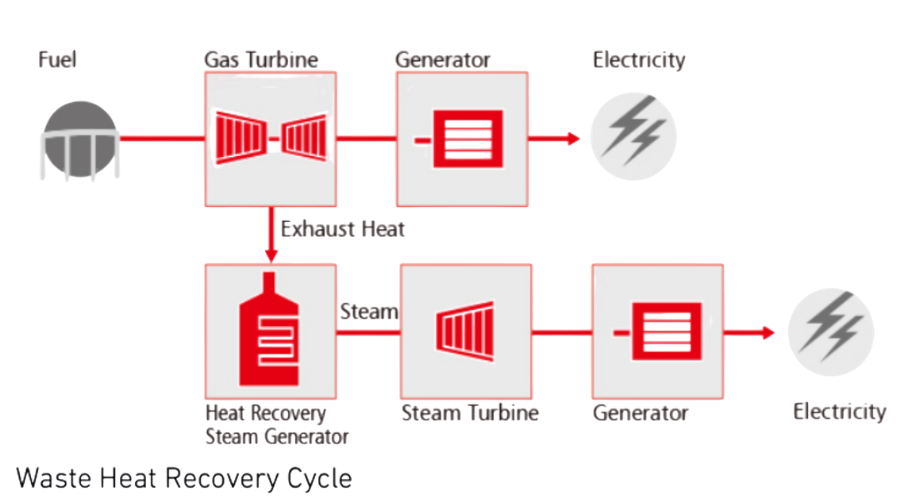
Our Challenge
‘Oxidizing’ or burning fossil fuels also produces substantial amounts of carbon dioxide (CO2), a greenhouse gas contributing to our climate change. The Washington State (WA) Climate Commitment Act (CCA) requires that as early as 2030, Clark PUD must begin limiting use of the RRGP and shut down the Plant no later than 2045. That will leave a significant hole in the resources Clark PUD can call upon to meet growing electricity demand.
CH₄ + 2O₂ → CO₂ + 2H₂O
At the same time, WA is encouraging the development of renewable energy sources like Wind and Solar power. These are a major source for our future energy landscape as we transition to more renewable, carbon-free energy. We can and already are deploying vast amounts of wind and solar and can develop enough to meet our needs, especially our summer peak loads driven by warm weather and heat waves.
But, we and our Utilities supplying essential power face two challenges: meeting both our summer peaks and our winter demands, especially during severe cold snaps. Winter is especially challenging: The Pacific NW sees little solar energy during the winter as our days grow shorter. And, the weather systems bringing us the most severe cold snaps typically are the result of ‘static high-pressure systems setting up over the Cascades’. That means there is also almost no available wind energy. We have traditionally relied on the BPA supplied hydropower, but that is a static amount, at best and our loads are growing substantially as we eliminate carbon-based fuels and strive to electrify everything.
An Opportunity
Developing sufficient wind and solar resources to meet our summer needs must reach a level where we can provide sufficient electrical power in August and September which can be hot and when air-conditioning demand is high. But these months near the Equinox, when daylight is diminishing. Backing up to the Solstice, in May and June the output from the solar resources is much higher, it’s windy and what ever run-off we will get fueling the hydro system is coming down the mountain as our springs grow warmer. We will have way too much renewable energy at a time where our demand, (load) is light as the days are long and beautifully warm. The physics of generating electricity is that we must match generation to load: we cannot generate more electricity than we are using, or really bad things happen to our grid. Our only present option is to turn off the surplus generation.
What if we could store this surplus generation from the summer Solstice to use during the winter months? Electro-chemical batteries currently used by utilities are only useful for storing energy for hours or at most days. Over a period of months, the charge deteriorates - and these are expensive!
A solution is to convert the surplus electricity to hydrogen (H2). This can be stored safely using new commercial technology such as ‘powdered metal hydride’ (PMH) filled steel tanks. The H2 bonds to the PMH so even if a tank is punctured, the H2 remains inside. (Slightly heating the tanks allows the H2 to flow freely) And, if the H2 ever does leak, it forms water vapor and is dissipated into the atmosphere.
Using Hydrogen
In the spring, we can transmit the surplus renewable electricity to the vicinity of the RRGP and there convert the electricity to H2 and store onsite. While our transmission system is largely constrained, during the spring when loads are light there is available capacity.
When we need the RRGP, we can initially begin blending the H2 with the CH4 to run the CCGT. In effect, instead of burning CH4, we are burning CH5, CH6, … . We get even better performance since less carbon means that more of the reaction energy is delivered to the turbine as heat, instead of to produce CO and CO2. And, we are producing less CO2, helping us comply with the requirements of the CCA while utilizing a vital source of electric power.
Implementation
Using H2 to supplement CH4 at the RRGP will require Clark PUD to invest in new equipment, and these investments cost money. Fortunately, we have four (4) years before we the CCA requires us to limit CO2 production. We can start small and when successful, scale up incrementally.
The systems required to convert electricity to H2 and store onsite are highly modular. We can begin with a modest investment that will not impact our rates and begin by blending small amounts of H2 with the CH4 as a ‘proof of concept’.
Annually, we can continue to invest in more H2 modules and gradually increase the amount of H2 introduced into the combustion process. There are limits to how much H2 we can blend into the RRGP fuel stream. But, the RRGP undergoes periodic major maintenance where we open the turbine and replace turbine blades. This will give us an opportunity to retrofit turbine blades compatible with higher percentages of H2. Eventually, over a decade as our onsite h2 production grows, we could be fueling the plant with substantially less methane driving towards a future, 19 years from now when the RRGP is 100% h2 fueled with ‘green’ H2 produced exclusively from renewable energy sources.
We made a substantial investment in the RRGP. Progressively limiting its use and abandoning it in 2045 would be a significant financial loss to our public utility. Adapting it to run on renewable, green energy allows us to amortize that major investment decades into the future, while significantly helping us to eliminate carbon pollution and providing the essential electricity we depend on!
Seasonal Energy Storage and the River Road Generating Plant (RRGP)
FUTURE PROOFING THE NORTHWEST ENERGY LANDSCAPE
